
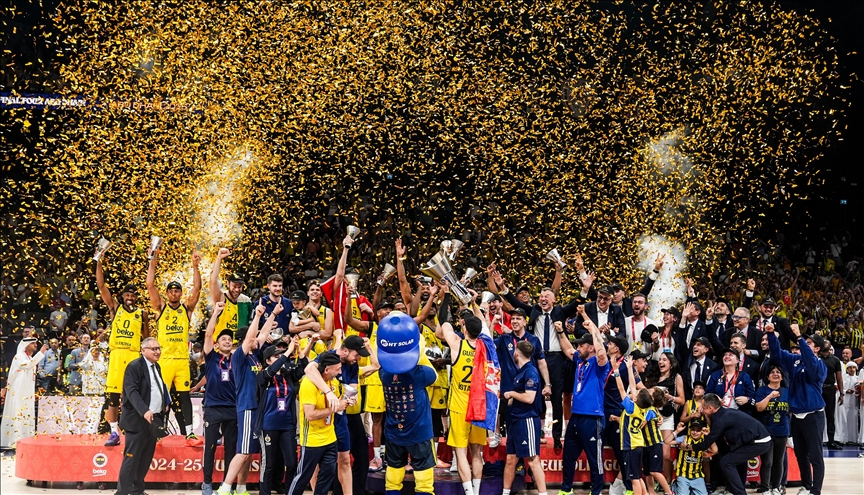
FENER THE GREATEST: FROM COLLAPSE TO THE CROWN
After 2017, time kept moving forward, but for Fenerbahçe Beko what was missing was not just a trophy, and it was an unfinished story. The 2018 final was not simply a lost game, but a wound that stayed in memory. In 2019, there was peak performance, leadership, and perfect structure, but the season fell apart due to injuries. In 2020, COVID-19 stopped the world, arenas went silent, and the rhythm was lost. 2021, in one word, was a below-average experience. In 2021–22, a leader emerged and hope was rebuilt, but once again it became clear that basketball is not a one-man game. The first half of the 2023–24 season was chaotic, uncertain, and lacked identity. Different leadership roles were tested with various players…
Until 2024 December, when Šarūnas Jasikevičius arrived. From that moment on, roles became clear, the system simplified, and the team rediscovered itself. Leaders emerged, transition plays gained meaning. This was no longer just a rise—it was the rewriting of an unfinished story.
1. LOW EXPECTATIONS
The 2024–25 season did not begin as a fully established dominance, but rather as a structure searching for identity while clearly showing potential. Offensive rhythm was inconsistent—sometimes driven by individual brilliance, sometimes by unpolished sets. The team was winning, but it did not yet feel like full control.
In the middle of the season, under Šarūnas Jasikevičius, the system gradually took shape. Roles became clear, defensive intensity increased, and the offense evolved into a simpler but far more efficient structure. The goal was no longer just scoring, but disrupting the opponent’s rhythm and forcing the game into Fenerbahçe’s tempo. Expectations were low, but belief kept growing. Especially Nigel Hayes-Davis’ clutch scoring moments strengthened the feeling that this team was becoming something different.
2. PARIS SERIES – THE NIGEL EFFECT
In the playoffs against Paris Basketball, the story started much tougher than expected. Even though Fenerbahçe Beko were the favorites, Paris completely disrupted the rhythm with high tempo and aggressive guard play. The game turned from controlled basketball into a chaotic pace battle.
The turning point came when Fenerbahçe lost its tempo. Paris constantly triggered early defensive pressure, forcing rushed decisions. In those moments, the offense collapsed into isolation-heavy possessions, which was not enough.
But the series changed with Saras’ adjustment. Tempo was slowed down, the defensive line was raised, and the second unit brought energy. Colson’s intensity, Khem Birch’s physical presence, and Tarık’s discipline turned the game into a physical control battle. Fenerbahçe learned a key truth: this series would not be won by shooting—it would be won by killing the tempo.
3. FROM WADE TO DEVON – BALANCE MOMENTS
The series against Panathinaikos B.C. turned into a completely different kind of war. Physical intensity and aggressive defense heavily disrupted Fenerbahçe’s half-court offense. In the early stages, the team tried to solve everything through Wade Baldwin, but the rhythm kept breaking.
At that point, Devon Hall brought balance to the game. The veteran “old monster” Eric, who arrived mid-season, stepped up in clutch moments during the playoffs and beyond. With his defensive toughness and smart decision-making, he kept the team steady. Then Saras’ system took over; the tempo was brought under control, the defense became more physical, and Panathinaikos’ transition game was shut down.
In the final stretch, the trio of Colson, Khem Birch, and Tarık changed the direction of the series. It was no longer about individual brilliance, but collective control. The series ended with Fenerbahçe not just beating the opponent, but beating the pace of the game itself.
4. THE FINAL – CONTROL AT ITS PEAK
In the final, the opponent was AS Monaco Basket. The game unfolded as a controlled form of tension from start to finish. Monaco tried to break the rhythm with physicality, but Fenerbahçe stayed calm, relied on half-court structure, and built the game step by step.
In the second and third quarters, the difference was not superstar explosions but system patience. Wade and Nigel created key moments, Guduric and Hall stabilized the flow, and Melli locked down the defensive core. Bench contributions became the invisible force that killed Monaco’s momentum.
By the fourth quarter, the story was already written. Monaco forced mistakes, while Fenerbahçe consistently made the right decisions. Marko Gudurić, long seen as underperforming compared to his potential, was reborn—his late contributions sealed the game. As the score reached 81–70, control fully belonged to Fenerbahçe.
And the final was not just a trophy—it was the peak of an identity built over an entire season. MVP Nigel Hayes-Davis summarized it in one sentence: the right decision at the right time, championship through the right system.
EN BÜYÜK FENER!