
PART 1 — ANATOMY OF COLLAPSE
Watching TV series has never been just a way to kill time for me. For some people, it’s background noise; for others, an addiction. For me, it’s often about sitting in the same room with a character, staying silent with them, making mistakes alongside them. That’s why the idea of an absolute “best series” ranking has always felt incomplete to me. Because what’s good is sometimes technically flawless, and sometimes it simply arrives at the right moment, in the right state of mind.
This list exists for exactly that reason. There is no perfect chronology here, no obsession with IMDb scores. I deliberately mixed genres, placed fast-paced shows next to slow burns, and even paired series that feel too “unrelated” to ever exist in the same universe. Because what hooks me as a viewer isn’t genre, but atmosphere; not plot, but character; not story, but transformation.
What these series share is this: none of them leave the viewer where they started. A character you once saw as a hero begins to unsettle you a few episodes later. A side character quietly turns into the backbone of the story. A choice you swore you’d never make somehow feels justified by the end of an episode. That’s why minor character spoilers are unavoidable—because in some series, the real story isn’t what happens, but how people slowly come to terms with who they really are.
The list will be divided into several parts, but each part will contain its own form of deliberate chaos. Series that share the same emotional core but take completely different paths will sit side by side. The goal isn’t to choose “the best,” but to gather stories that pull you in, disturb you, and occasionally force you to ask: What would I do?
In short, this is the notebook of a viewer who judges series not by what they tell, but by what they leave behind. What follows will be character-driven, roughly 300-word reflections for each series—occasionally spoiler-heavy, always centered on feeling rather than plot.
If you’re ready, the chaos begins.
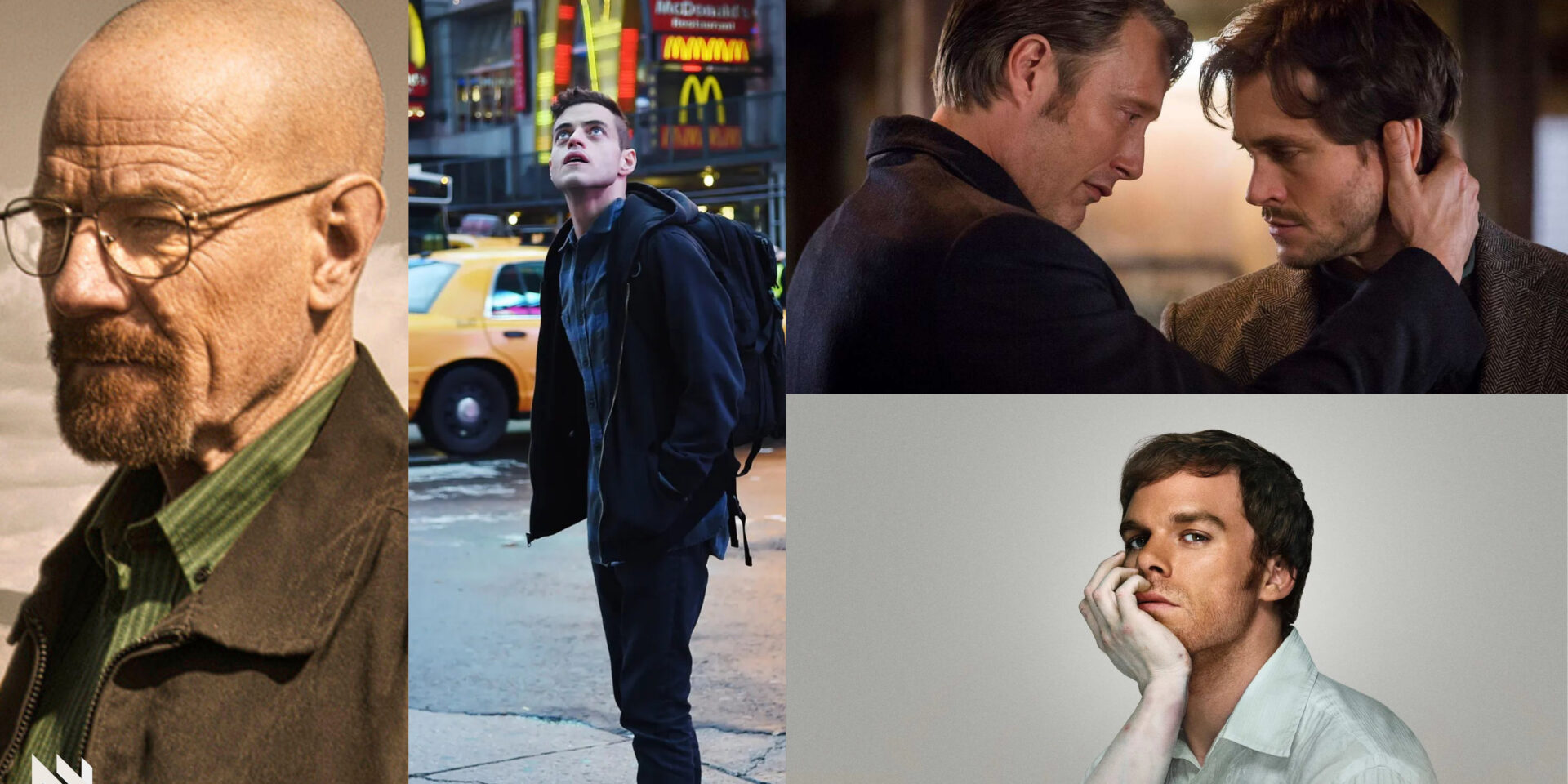
Hannibal (Hannibal Lecter & Will Graham)
Hannibal is not a crime series; it is the story of a dangerous bond between two people. Will Graham believes his empathy is a strength, but it leaves him exposed. Empathizing with killers slowly erases his own boundaries. Will’s psychological unraveling isn’t sudden—it’s quiet, gradual, and unsettling.
Hannibal doesn’t want to break Will; he wants to draw him closer. He doesn’t manipulate in obvious ways—he simply says the right things at the right moments. He doesn’t make people do things; he legitimizes what they already want to do. That’s what makes him terrifying.
The line between friendship and obsession is constantly blurred. Conversations between Hannibal and Will begin like therapy sessions, but each one poisons the relationship a little more. As a viewer, you’re pulled into this dynamic whether you want to be or not.
Hannibal’s aesthetic is a deliberate trap. Violence is disturbing, yet beautiful. That contradiction turns the viewer into an accomplice. Hannibal ultimately asks a dangerous question: If evil were this elegant, could you really resist it?
Dexter (Dexter Morgan)
What makes Dexter Morgan interesting isn’t that he’s a serial killer—it’s that he learned how to be one. He doesn’t act on instinct; he follows rules. The “code” passed down from his father replaces his conscience. Dexter doesn’t suppress evil; he organizes it. What we watch isn’t murder, but a constant attempt at balance.
Dexter’s internal monologues are his most honest moments. Even when he smiles, builds relationships, or tries to appear “normal,” there’s always distance beneath the surface. Love isn’t natural to him; it’s a learned behavior. Even his relationship with Rita is partly performative—when real emotional attachment becomes possible, he panics.
The most disturbing aspect of the series is how difficult it becomes to judge Dexter. The people he kills are “bad.” The show deliberately drags you into this moral swamp. Over time, the idea of who “deserves” to die begins to stretch—and so do Dexter’s own limits. As the code erodes, so does he.
Dexter’s greatest fear isn’t getting caught; it’s being truly seen. Having the mask fall is more threatening than death itself. That’s why, as the series progresses, the tension shifts inward. The real question becomes: can Dexter actually change, or does he only learn how to hide better?
Mr. Robot (Elliot Alderson)
Starting Mr. Robot with hacking is still a mistake. Elliot Alderson isn’t a programmer—he’s a socially detached individual. His distance from people isn’t a choice; it’s a survival mechanism. What we witness throughout the series isn’t a revolution, but a psychological defense process. Elliot’s inner voice is often louder than reality itself.
The figure of Mr. Robot initially appears as a guide, but is actually the physical manifestation of Elliot’s suppressed anger. He says what Elliot can’t, does what Elliot won’t. Over time, the question of “who is real” becomes irrelevant. What matters is which version keeps Elliot functional.
Elliot doesn’t occupy a clear moral position. He hates corporations but keeps people at arm’s length. He wants to help but can’t connect. Every victory isolates him further. Cinematography—empty frames, off-center shots, prolonged silence—visually reinforces this loneliness.
Mr. Robot forces you to identify with Elliot while simultaneously questioning him. You believe him, but you don’t trust him—because he doesn’t trust himself. The show’s real achievement isn’t its hacking sequences, but its ability to sustain this constant sense of uncertainty.
Breaking Bad (Walter White)
Breaking Bad isn’t a crime series; it’s a transformation documentary. When we first meet Walter White, he’s weak, suppressed, and invisible. The show’s greatest strength is how it builds his transformation not through sudden breaks, but through small, logical, defensible steps. Walter doesn’t jump into evil—he walks toward it.
Walter’s biggest lie isn’t to others; it’s to himself. “I’m doing this for my family” becomes a defensive mantra as the series progresses. As his power grows, his need for excuses fades. Heisenberg is the liberated version of Walter’s repressed ego.
Jesse Pinkman acts as the moral mirror of this transformation. Jesse makes mistakes, falls apart, feels guilt. Walter rationalizes everything. This contrast keeps the moral tension alive. At some point, you realize: Walter White is no longer the hero—yet the story still revolves around him.
The most unsettling part of Breaking Bad is that, at times, you find Walter justified. That’s where the show strikes hardest. It convinces you with the right words spoken by the wrong man. And by the end, only one question remains: Was Walter White always like this—or did we agree to watch him become this?